
Kim DohYon
Hardware Engineer & FPGA Specialist
Electronic and Electrical Engineering student specializing in FPGA development, High-Level Synthesis optimization, and AI accelerator design. Currently researching workload-aware interconnect networks for AI accelerators, with focus on addressing communication bottlenecks in large language model scale systems.
Research Objective
My research objective is to design workload-aware interconnect networks for AI accelerators. I aim to address the communication bottlenecks that occur at large language model (LLM) scale. As chips scale to accommodate massive models, the growing number of compute units and routers introduces substantial complexity to network management. Severe congestion challenges emerge that traditional methods cannot handle efficiently because they are often too rigid or computationally expensive.
Education
Sungkyunkwan University
Republic of Korea
B.S. in Electrical and Electronic Engineering
Double Major in Advanced Semiconductor Engineering
Overall GPA: 3.54/4.0Gyeonggibuk Science High School
Republic of Korea
A specialized high school for academically gifted students in mathematics and science.
Experience
Rebellions
Hardware Engineer Intern – Tape-out Participation
NPU Memory Subsystem & NoC Analysis (Oct. 2025 – Present)
- Developing an automated SRAM compiler to generate parameterized memory wrappers with built-in clock domain crossing logic and error protection, improving reliability for datacenter-scale NPUs.
- Analyzing on-chip mesh router topology to identify deadlock points; collaborating on architectural solutions for deadlock-free packet routing.
Hash Algorithm Accelerator (Jun. 2025 – Oct. 2025)
- Led logic design in a three-person team to develop a SHA-512 accelerator using HLS and OpenCL, spanning from microarchitecture exploration to FPGA deployment.
- Achieved 2.4 GH/s throughput and improved performance-per-watt by 14.2% over the RTX 4080 via loop unrolling and dataflow pipelining.
- Architected a distributed system leveraging dual-FPGA clustering to scale throughput for high-volume client workloads.
Intelligent Signal Processing Laboratory
Undergraduate Researcher
Sungkyunkwan University · Advisor: Professor Wansu Lim
Conducting research on hardware-software co-design, ranging from algorithm development to silicon bring-up. Gaining end-to-end perspective on computational accelerators and efficient hardware solutions.
KATUSA
Sergeant, CBRN Non-Commissioned Officer in Charge (NCOIC)
Korean Augmentation to the U.S. Army
Served as a liaison and interpreter for U.S. Defense agencies (DTRA, DOE) and Republic of Korea military officials throughout the full term of service.
Research Experience
Scalable Distributed Acceleration
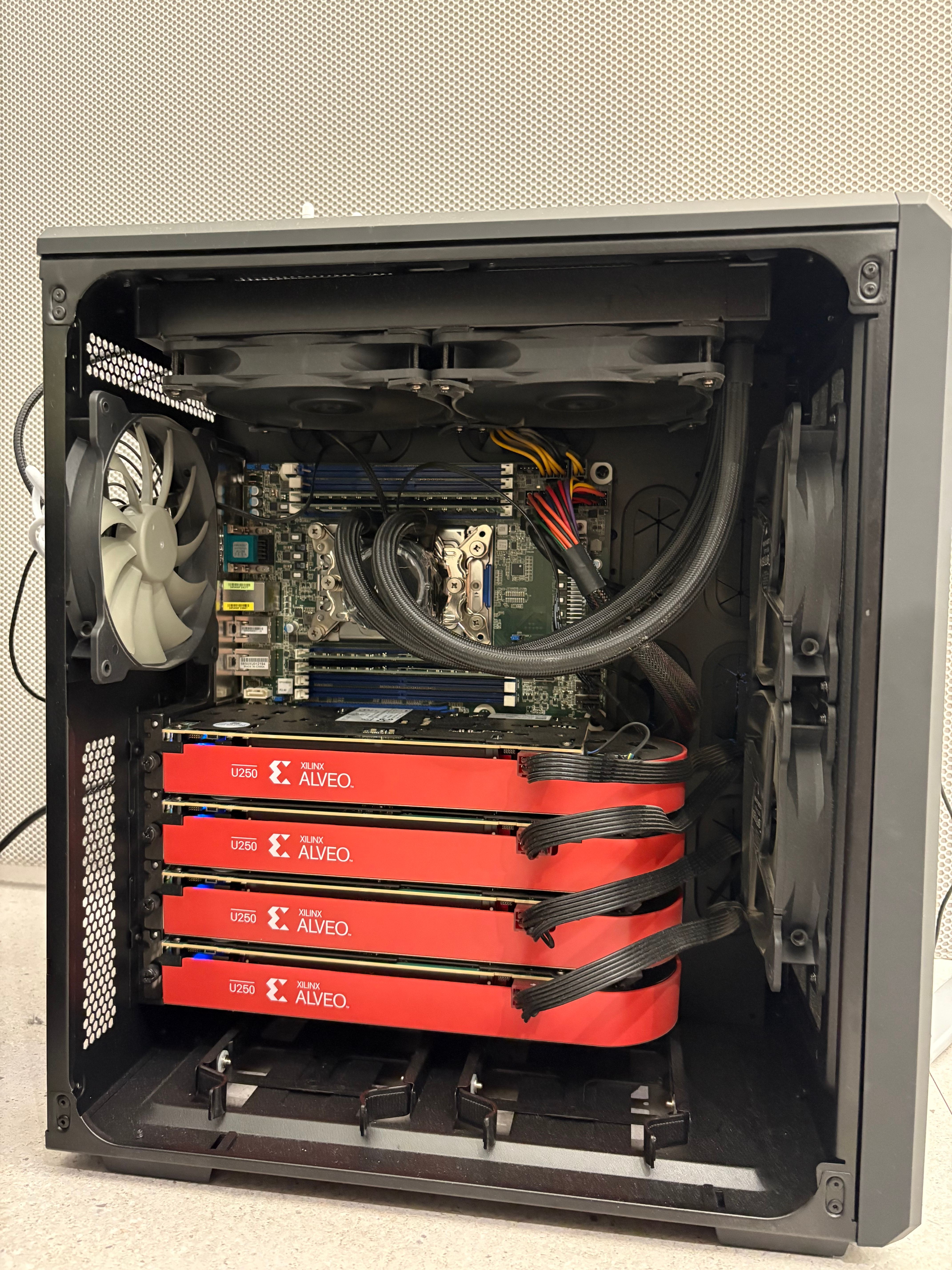
SHA-512 Accelerator on Xilinx Alveo U250: Served as logic designer in a three-person team, architecting and implementing a SHA-512 accelerator. Achieved 2.4 GH/s throughput and 14.2% improvement in performance per watt compared to RTX 4080 baseline.
Initially employed explicit stage-by-stage pipelining to maximize operating frequency, but identified severe routing congestion due to excessive flip-flop usage. Resolved this by minimizing pipeline stages through partitioning wide arithmetic logic and migrating critical adders from LUT fabric to DSP slices.
Deployed the design on a dual-FPGA server and validated stability through multi-day stress tests, gaining direct experience in constructing distributed systems.
Hardware-Aware Neural Architecture Search (NAS)
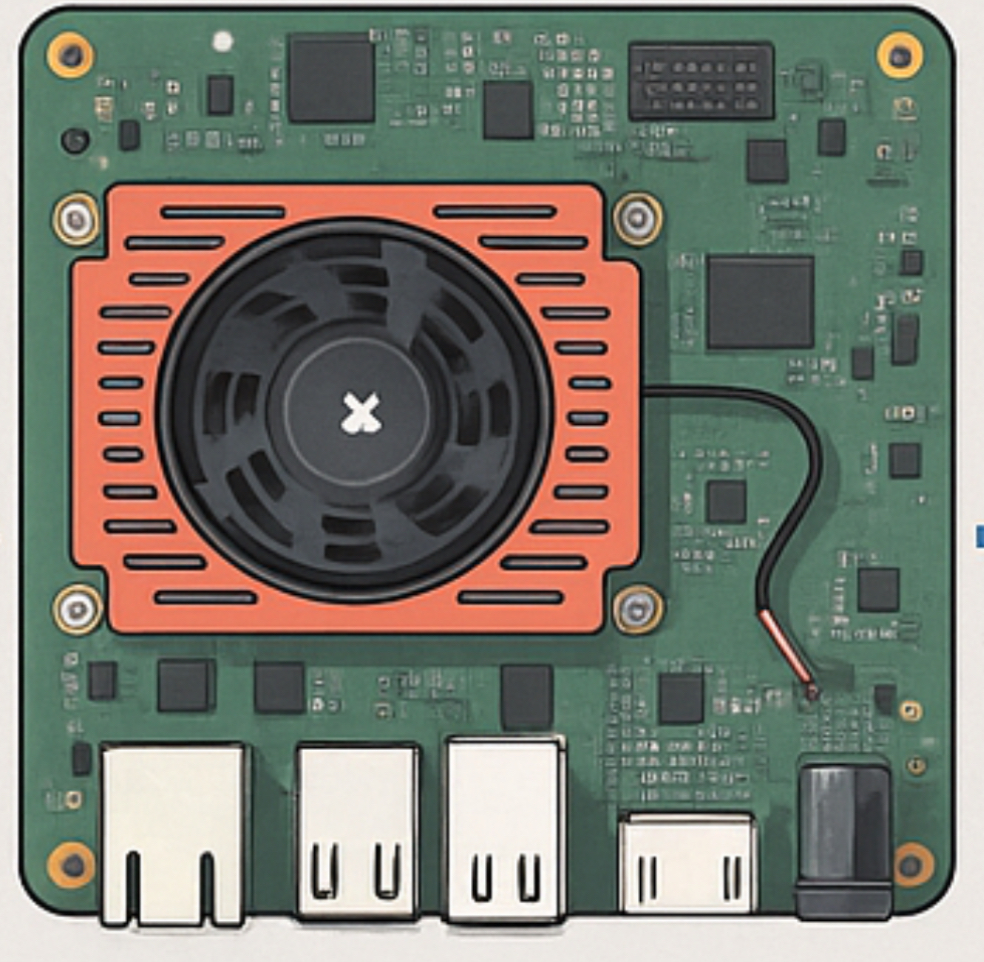
UAV-NAS Project: Focused on hardware-algorithm co-design for efficient drone detection. Initiated this work to address the structural irregularity of existing models that hinder efficient edge deployment.
Key insight: The repetitive structure of NAS-derived cells allows for serialized execution of compute units, significantly reducing energy consumption. By deploying the resulting network on a Xilinx KV260 FPGA, achieved an 88.6% energy reduction compared to CPU inference.
📄 Publications & Preprints
"UAV-NAS: Novel UAV Identification using Neural Architecture Search on FPGAs"
Doh Yon Kim et al., IEEE Transactions on Industrial Informatics (Under Review)
- Designed the algorithms and HLS optimizations for a neural architecture search framework.
- Achieved 88.6% energy reduction compared to CPU implementations while maintaining real-time throughput.
Projects
Llama2.c Acceleration on FPGAs
Dec. 2024 – Aug. 2025
Finalist, Creative Innovation Research Program. Investigated HLS optimization strategies to accelerate large language models on FPGA platforms, focusing on memory bandwidth bottlenecks.
High-Level Synthesis Library for Deep Learning
Dec. 2024 – Jul. 2025
Finalist, Co-Deep Learning Project. Developed a modular HLS library to streamline the deployment of deep learning models, bridging the gap between software frameworks and hardware implementation.
Drone Signal Classification with FPGA
Jan. 2025 – current
Selected as a finalist in the Capstone Design Fair. Implemented real-time drone signal detection and classification using FPGA and NAS (DARTS) model for edge devices.
Awards & Recognition
Joint Service Achievement Medal
Awarded by UNC/CFC/USFK Commander (Four-Star General)
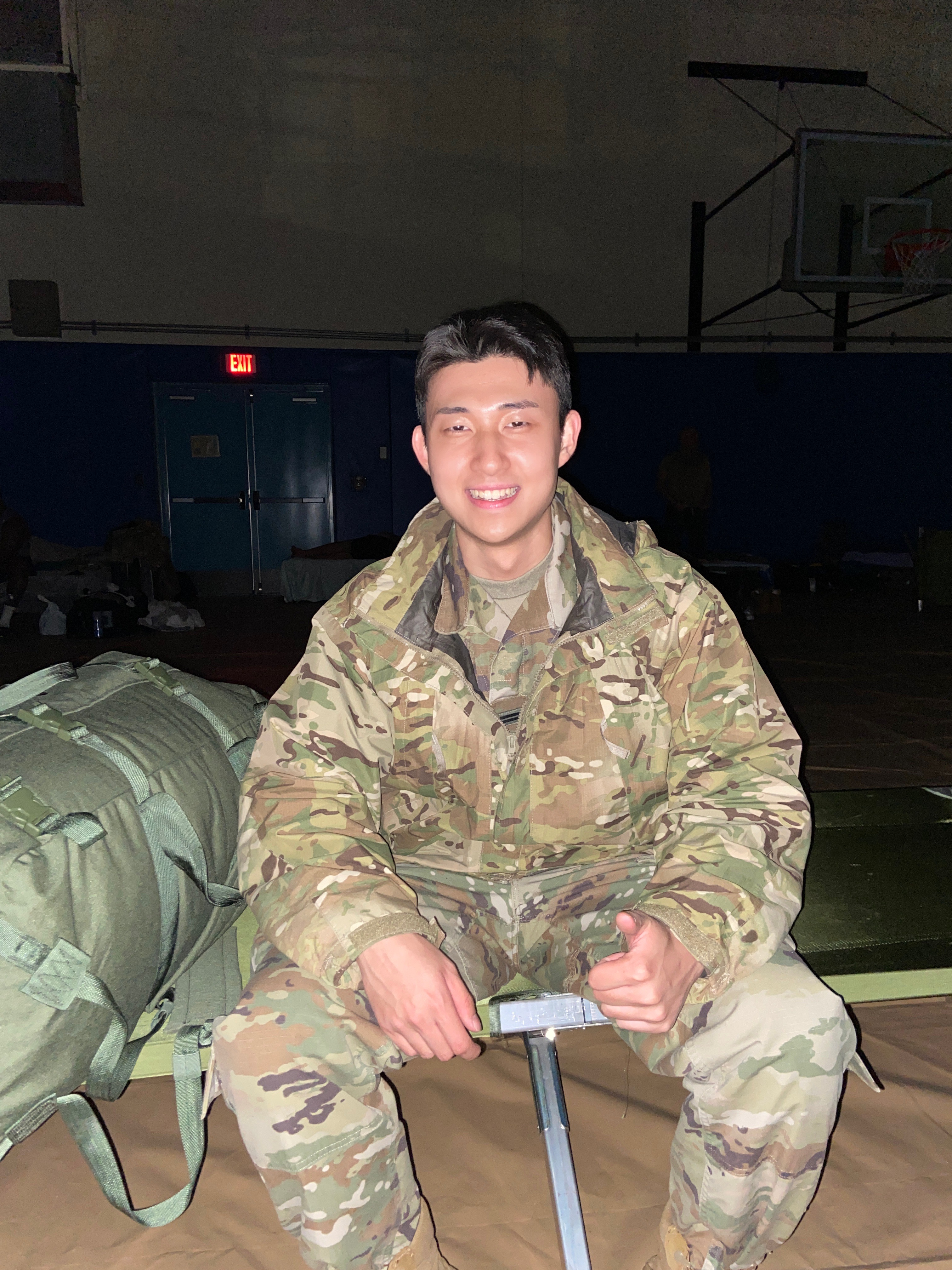
Recognized for developing the Republic of Korea Army's chemical, biological, radiological, and nuclear (CBRN) response plan and implementing it during training exercises.
Skills & Languages
Technical Skills
Languages
Tools & Frameworks
Hardware
Languages
English
OPIc Advanced Low (Aug. 2024) - Highest proficiency level
Korean
Native